Showing posts with label education. Show all posts

Saturday, March 12, 2011

Weird connections: the method in madness

After Amy Chua and Darwin one must be thinking what next? The connections seem to get weirder than ever since the time the discussion on learning began. That is precisely what is aimed at: To look beyond what the system tells us to think. To search for new perspectives.

We already have the perspective of the glass half empty or half full. What will we see when we have a bird's eye view of the same glass? The question is impertinent. Irrelevant. Unnecessary in our world. Or, rather we are cajoled into thinking so. Let's just get out of the overcoat of rational thinking and look around the real world.

Mankind is looking forward to creating inhabitable spaces in the moon. And this is not  material for science fantasies only. The Indian Space Research Organization has discovered an underground chamber in the moon's surface where a human settlement could be erected.
The settlement would be protected from radiation, micro-meteor impacts, dust and extreme temperature changes by the lava structure that provides a natural environmental control with a nearly constant temperature of minus 20 degrees Celsius (-4 degrees Fahrenheit), unlike that of the lunar surface showing extreme variation, maximum of 130 degrees Celsius (266 degrees Fahrenheit) to a minimum of minus 180 degrees Celsius (-292 degrees Fahrenheit) in its diurnal (day-night) cycle. (From this article)
At such a juncture in the history of the human civilisation, when change is the only thing that is becoming constant, do you still want to believe that all that we should be doing has already been  apprehended and we just need to follow the blueprints?

These are the changing scenarios in this changing world. The more we accept the cosy couch of the factory mode of learning, the more we choose to look away from the reality of the existence in the now.

The argument that may peek out of your minds as you read this is: How can you plan to address these issues when faced with diversity and population? 

May be all that we can choose to do is affect change in our little lives. Choosing to encourage questioning. Choosing to walk the paths not only with the purpose of material achievements. Choosing to make ourselves and the next generation thoughtful beings, aware of the needs, the changes and the possibilities this world and its inhabitants hold in them. 

The question that occurs immediately in the mind is: Does this ensure any impact in the larger scenario? Well you never know what the n th number of generation from now will be thinking. But short-sightedness is not the natural vision; is it?


Monday, March 7, 2011

Weird connections : Necessity, Evolution and Learning

What did those ancestors of ours thought when they drew bisons on the cave walls, perhaps in the light of a burning wood. Perhaps there were others looking at awe at this unique phenomenon of capturing, in a completely new sense, what they see running and throbbing amidst the landscape. Perhaps they were dumbstruck that something like this can happen. Perhaps the first artists in the history of mankind were shunned from the group. Or, perhaps the artists were hailed as supernatural beings. Perhaps it was at this point of time in human history that the idea of creation most poignantly emerged separately from the history of necessities that made man. Necessity is said to be the father/mother of all inventions. Necessity is also the reason there are discoveries. Had there been no urge to find new sea-routes, the landmass we call America would have never been discovered. (But that is another story altogether). What if we go a step further and say, necessity is also the cause of evolution?

Evolution is cryptically defined as the Darwinian idea of the survival of the fittest. It is not the survival of the strongest. It is not the survival of the most ferocious. It is a poetic truth actually. What can be more poetic than the radical cocktail of the element of chance (not so radical in the post- Quantum era though) and the primal urge of survival? Had the human ancestors not felt the radical urge to continue existing in a world that is naturally more powerful than humans ever thought of being, the history of mankind could have been lost in the voids of time.

As mankind trekked through its own history, Darwin's adage was seen as a scientific truth, detached from the reality of our worlds. Power became the stronghold of survival. And humans believed it; they continue to do so. Histories and myths of once great and thriving, and, now extinct civilisations are not very hard to find: the Harappasn civilisation, the ancient Egyptian, Greek,  Roman civilisations, the native American civilisations. And yet, man believes that, that is different. Humans believe that they exist as a continuity of the past civilizations. In terms of genetics, it may be so. In terms of the basic science of Darwin, may be not. 

In  an Old- English poem, a refrain occurs : "That has passed and so shall this". It was a refrain in an elegy, a poem about loss, a poem of lamentation. In that context, this is a hopeful, stoical view of life. Darwin's theory of survival of the fittest seems to be a variation of this refrain. What has survived in pre-historic eras - the wide variety of dinosaurs, the mammoths, the Archaeopteryx (possibly the first bird)- is lost in this present time. What is in this time, may as well be lost in some future time. And yet, Darwin's theory is but a story in the history of science.  

Does this mean we have a meaningless existence? Existence is the meaning we give to this present moment; what meaning it will have in future times we can only speculate. The most profound quality thatthis rather young species in this world needs is perspective.

Herein, interjects the history of the human civilisation and our ongoing discussion of learning. There are differences between what was done, what can be done and what can't be undone. The human learning process does not initiate the mind in seeing the difference between each of these. Education in this modern world is still largely something like the factory production system. There is no  one better to explain this than Ken Robinson in his admirable light-hearted and yet forceful way. 


(to be contd.)


Thursday, February 17, 2011

Learning in the Regime of Success 2

The problem is the way we define success. 

In our minds, an equation of success is somehow defined. Success, we believe, is the same as  achieving fame and material well-being. Neither of the pre-requisites of being successful are evil by any chance. The question that follows is: what will make you a success? The answer, however, is indefinite. 

Could following the life path of the successful people, doing exactly the things they did, lead us to success? It's doubtful when cooking the same recipe usually yields different results. 

However, there is one thing that we can try to inculcate from the lives of truly big-shots. To be hard-working, to concentrate on a chosen area, to be dedicated to it in spite of experiencing repeated road blocks. Sounds simple, doesn't it?

Well, this simple potion can be administered to aim towards excellence. This 'success' is of a different kind however. It involves achieving the highest potential in the self . But, isn't that what the 'tiger' mother wants too? Yes, it is. But here we have a major shift in perspective . 

While  in the regime of the 'tiger' parent, discipline is imposed, in the regime of excellence, discipline is a way of living advocated by the self. 

In the regime of success, envisioned by the 'tiger' parent, the child is an object of the demands from the outside, and disciplining imposed by an other. In the regime of success directed at achieving excellence, the child is a subject in the vision s/he dreams for her/imself. 

Learning the art of disciplining the self is a necessary quality of living a worthwhile life. Learning to face the responsibility of a decision taken by the self is a pre-requisite of a meaningful life. Learning to encounter incompleteness and moving on after accepting it is the rare quality that you can bestow on someone in this battlefield called life. Instead of encouraging being a thinking individual, why are we then hell-bent on creating a batch of Agent Smith-s in the matrix of our lives?

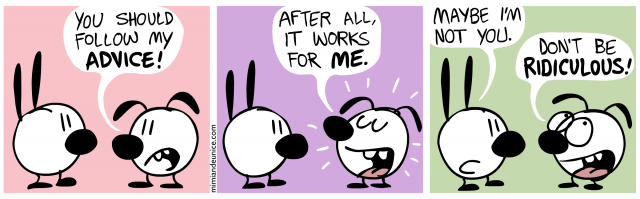
Or, do we think like Mimi and Eunice ?


Are we ready for the unlearning needed to successfully achieve excellence?


 Mimi and Eunice cartoon by Nina Paley


Thursday, February 10, 2011

Learning in the Regime of Success 1


When we look around us and see the bubbling of corruption, unrest, inhuman acts and desires born out of hatred and anger, we are forced into the corner of self-questioning. Where is it that the world has gone terribly wrong? The list of such things is endless and as varied as the number of the stars in the sky - living or dead. The root is difficult to identify. The off-shoots are too many.Yet, if we listen to the throbbing of our own pulse, the drive that moves the human self to development as well as to destruction, is, 'fear'. And this 'fear' necessitates obedience in order to maintain the scheme of things.

Tuesday, February 1, 2011

Leading to learning: unlearning

This strange word - unlearning - is confusing.

To be educated is, we suppose, to learn. We learn different ideas, numbers, facts and details. We learn that they must be applied and re-applied. This mumbo-jumbo of information fed into our brains appear to be pretty much the foundation of our future lives.

It is only when we leave the backpacks filled with textbooks, and, carry the trendy sling bag of regular life, that we realise the uncanny need to unlearn. We somehow feel that the learning of the yester-years is not enough. And then, we are in for a shock. We haven't learned to unlearn at any earlier point of time in our education! We didn't realise earlier that getting the highest grade in school is but one chapter in our lives!


Unlearning is nothing but beginning a new cycle of learning. This doesn't seem a tough task, does it?

It is elementary. But the problem is that we are trained in a school of thought that establishes repetition as the necessary idea. Unlearning is all about forgetting, or rather, letting go, of this habit of repeating. That sounds simple, but it's terribly difficult.


To be always a soft pile of clay is a challenge. To be a soft pile of clay once more, after it has been moulded and it has gained a form, appears impossible.

CAN A MIND THAT HAS BEEN MOULDED IN A PARTICULAR MANNER UNDO THE FORMER METHOD TO LEARN AGAIN?

Calvin and Hobbes comic strip © Bill Watterson and Universal Press Syndicate.