the wind plays merry-go-round,
the grass bows near your feet,
clearing the streams,
making pathways to somewhere
you feel the bending wind
rushing through your veins
the madness of life
straining through the thumb
that press down the eye of the tornado-
it is dreadful to be there alone.
you may be brushed from the soil
and piled at another place, in another din.
the bones may rattle
with the newness of the blow,
and guard you into a shell ...
and yet,
the storm brews something in you
something with flavours.
something, you can feel.
you've never seen the skies so drunk,
you gesture them to calm down
but sobering seems a strain.
cut out the past in cardboard shapes
hang it in loose circles near the window
open the panes-
you may be the eye for a while.

Showing posts with label poetry. Show all posts
Showing posts with label poetry. Show all posts
Thursday, January 6, 2011
Friday, December 17, 2010
group photo
the tilts, the bends,
the degree to which
the lips must strain,
the gesture that's game.
the snickers pale
highlight the crunch,
the undo-able stretch
achieved in a darn!
it rubs off the skin
the glory, the shine.
they wear a grin
same as the tie
black in the blizzard
yellow like a dime
pink in love
gray to cry
the stunt they need
the spoon they feed
the curl they rear,
the fear of a tear
in the couch
with crackers
and
a huge teddy bear.
wishes are whims
whispering ally,
smiling in clay
wishes may lie.


Wednesday, December 15, 2010
creepers
having spread the wings, twittering and gnawing against the bark, the creepers nigh through the winds :
out of the basic cone that spirals down the spine.
at the foot of the spine is the breathing boots:
lungs of the womb that soil the soul.
they need be there, at the foot, ugly and grim, dirty with tentacles of dreams,
it need be there- silent and scarce to the eye.
else, we need the shades when the solar schemes shine.

Image: Creepers, Prague; by self.
out of the basic cone that spirals down the spine.
at the foot of the spine is the breathing boots:
lungs of the womb that soil the soul.
they need be there, at the foot, ugly and grim, dirty with tentacles of dreams,
it need be there- silent and scarce to the eye.
else, we need the shades when the solar schemes shine.
Image: Creepers, Prague; by self.
Friday, December 10, 2010
life path
I don't know which wave is rushing towards me
as I carve the wood
fetch the kid,
sew the blouse,
take the red broom out of its box ...
I have a sledge that drives me through the glaciers
as I pick the sparrow,
tie a love around its neck
and flee -
... the clouds in the dreams ...
And yet, I do not know which wave is my guest tonight.
I will wait for it in the woodpecker's hut.
A few sustaining drinks later,
We will walk down the garden path
and climb the stairs to the centre.
At that era of being,
I will name the wave, christen it
with the dark waters of the cesspool.
Till that elevation I must wait
without knowledge
without wisdom
carving my wood, like Sisyphus in his dreams.

Image: by self; Mytilini, Lesvos islands, Greece 2010.
as I carve the wood
fetch the kid,
sew the blouse,
take the red broom out of its box ...
I have a sledge that drives me through the glaciers
as I pick the sparrow,
tie a love around its neck
and flee -
... the clouds in the dreams ...
And yet, I do not know which wave is my guest tonight.
I will wait for it in the woodpecker's hut.
A few sustaining drinks later,
We will walk down the garden path
and climb the stairs to the centre.
At that era of being,
I will name the wave, christen it
with the dark waters of the cesspool.
Till that elevation I must wait
without knowledge
without wisdom
carving my wood, like Sisyphus in his dreams.
Image: by self; Mytilini, Lesvos islands, Greece 2010.
Wednesday, December 1, 2010
stopgap
At times too many thoughts and ideas crowd the top level of the body. It almost reminds me how the top of the mountain is usually painted as if shrouded in mists. Too many water particles getting heavy at the top. Guess am at that part of the mountain. The droplets of words and ideas are getting collected in various soul-buckets.
In the mean time, am sharing with you a translation that I did of the bengali poem, "Anandabhairabi" by Shakti Chattopadhyay, some time back. A special thank you to Supratikda for initiating me in this process.
The Joyous Bhairabi
By Shakti Chattopadhyay
in that room today, the image has dipped;
it wasn’t like this at the monsoons’ end-
with rain-drenched blooms in the gardens
was the joyous bhairabi.
no shepherd boy comes to that lea,
banyan roots shed no tear at the enchanting flute-
yet, when the rains dig through the clouds,
streaks of lightning are found.
wasn’t it known that such hard times
leap and seize the cock’s red crest?
wasn’t it known that in a squandered heart
the miser’s gains rest?
wasn’t it known, though the seat be vast,
the heartland is not known that much?
wasn’t it known, much that I know
is but oceans in the nails?
in that room today, the image has dipped.
it wasn’t like this at the monsoons’ end,
With rain drenched blooms in the gardens
Was the joyous bhairabi.
Translated by Susmita Paul
© 2010
Saturday, November 27, 2010
An experience in translation ...
As a kid I have read several versions of the fairy tale dealing with the two queens of a king: the selfish materialistic queen Suyorani and the humble,caring, non-complaining queen Duorani. The standard fairy tale version narrates the story of how the selfish queen ousts the humble queen from the palace and tries to keep her away, and how finally the worth of the banished Duorani is realised and she is brought back to the palace. Rabindranth Tagore's take on that fairy tale in his book of poetic prose Lipica deals with the story from a slightly different perspective. Tagore's tale is about the unhappiness that Suorani encounters in the palace of comforts. As I sit and read and attempt to translate Tagore's take of the fairy tale, I am drenched by waves of thoughts from different seas of ideas.
 |
| Duorani or Shuorani? |
Fairy tales charm the mind of the young and the old by virtue of telling a tale that has been told forever. We, the listeners, know for sure, that the evil will be defeated by the good by the end of the fairy tale. The allegory of the power of good that prevails over the power of evil has been narrated in various ways across the globe. And all such conventional fairy tales categorise everything in terms of binaries. Each and every character is either good or bad. There is no trait of one in the other. The lines that demarcate each are distinct. The structure of the allegory aims to teach; and the basic requisite of teaching is to demarcate and differentiate. This brings me to the thought-sea that churns questions like : Can everything be identified as either black OR white? If so, then where does the colour grey come from? Where is that space where BOTH black AND white exist? The waves of this sea leave me in the sands of words created by Tagore in Lipica.
The treacherous Suorani who had left no stone unturned to push the existence of Duorani to the brink of the kingdom of the king's heart, weeps with sadness in Tagore's take on the standardised fairy tale of Duorani-Suorani. In Lipica, his book of poetic prose, his version of the fairy tale is titled "Suoranir sadh" (Suorani's desire). Unlike all the desires that Suorani had in the wide-spread fairy tale, the desires that she experiences are non-materialistic. She does not desire fine clothes, precious jewellery or such stuff that can be quantified in terms of money. She desires simplicity of being, she desires the dignified calm of simple living, the joy and the warmth of the hearth. She desires the sorrow of Duorani...
 |
| Duoranir dukkho ami chai ... |
"oi duoranir dukkho ami chai ....or oi ba(n)sher ba(n)shite sur bajlo,kintu amar sonar ba(n)shi kebol boyei beRalem, agle beRalem, bajate parlem na."
I long for the suffering of Duorani .... her reed can create such music, but my golden flute I vainly carried along, guarding it and alas never being able to create music from it.
Image with caption "Duorani or Shuorani?" : Woman's face by Rabindranath Tagore, Ink on paper, n.d.
Image with caption "Duoranir dukkho ami chai..." : Lady with flowers by Rabindranath Tagore, Watercolour on paper, dated 28/9/37.
Images taken from the web.
Thursday, November 18, 2010
Puja Chronicles: Actual/Virtual
No one spelled it out. And yet, it was there. Like a star.
I always thought I had a non-scientific mind. When I looked up at the clouds, I could never recognise whether they were cumulus or stratus. I saw images. Of elephants, of Archaeopteryx (I loved to figure this out specially), of flying castles, of Santa Claus's face. I believed I was prone to imagination than rational thinking. Then, a few years into high school, and Physics introduced me to the world of constellations. Individual stars being a part of an image in the sky. I was baffled to know, science needs imagination.
That was the beginning (I guess) of questioning what seems to be 'real'. The absolute versions held ground for a long time since then, but the foundation of the idea of the 'absolute' had started eroding.
*****
Far away in the distance, there used to be a ball of gas. It started 'living' - burning itself up in order to radiate light/energy/life. It performed the balancing act of gravity and expansion. And then it had to die. It became a 'dwarf' or an eternity called 'black hole'.
 |
| Life cycle of a star |
*****
Is the star there as I see it now?
I can see it twinkling! It is actual, I guess. But, it may have died and its light is still crossing the seas of the universe to reach me. Does that make it virtual?
*****
Feeling homesick on a day when celebrations of a mother goddess fill my mother's house with laughter and joy. Before the deity leaves the threshold of the home, I skype home. I dress up as a traditional Bengali married woman - complete with sari, the jewellery, the vermillion on the forehead. I have arranged a candle, the vermillion (sindoor, the mark of marriage), a flower, an Arab sweet, a small glass filled with water on a dish. The camera looks into the face of the deity. From across the oceans, I hold the platter in my hands and perform an action that every married woman does at the end of the festival for any Hindu goddess. I boron (a ceremony performed to cordially welcome) the deity.
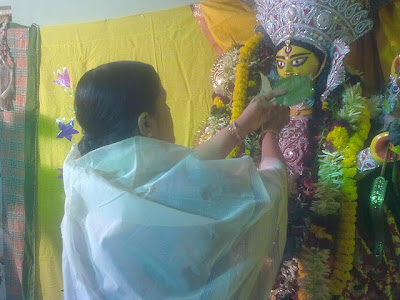 boron |
[It is strange that the festival begins and ends with the same custom of boron. Even when the deity is taken away for the immersion in water, marking the end of the festival, it is wished a good journey and an invitation to return in the next cycle of time.]
What I did was in real time but not in real space. Does that make it any more virtual or any less actual?
I do not know. The conventions of understanding the time and the space are somehow soiled by the sense of happiness I had at the end of the act. I felt as if I participated actively in the joy that exuded in the household for the past few days. I felt the warmth of having a family filling me in this chilly land. That is the perspective I choose.
Images:
"Life cycle of a star" from "Nebulas" in E.Encyclopedia Science on Fact Monster. Web.
"boron" : Image boron performed by my mother. The deity is that of the Mother Goddess Jagadhatri. © Susmita Paul 2010.
Saturday, November 13, 2010
A view ...
The worlds separated by the glass worlds melt in this room.
The lean wooden cupboards stand tall, the soft lights in the apartments across the pathway remain unmoved on it. The yellow light, at the entrance of the building opposite to the room, makes the presence of the 'de-leaved' trees felt.Looking a little observantly will actually reveal the last leaf on that branch, still waiting for the wind that will blow it to dust.
Nonetheless, the lamp in the room glows brightly. And, a few notches above, behind the thin film of darkness, caused by the rain-clouds, is a hemisphere of a moon. Little black patches of night imprinted on it, and a fluorescent white light- the light of the burning zeal of the sun, that some call 'life'.
A few miles beyond the glass, a soul is sick of the elements. On the other side of the glass, a strange unnerving sensation creeps up the spine of the phantom of solitude. A few nights beyond this night, the phantom and its soul sunbathe in sunshine-islands.
The lean wooden cupboards stand lean, soft lights smoothen the edges of the lanky towers. The yellow light, hanging at the entrance causes nausea to the insects and humans alike. A few notches beyond the light, across the luxuriating waters, a glowing ball of light fires up the sky. Streaks of colours spread across the sky as an inattentive hairdresser would spread the streaks on your hair. It is strangely nauseating - the colours.
Some may call that 'life'.
 |
| colours of water |

Image @ Self, 2010
Friday, November 5, 2010
Puja Chronicles:A memory
On the eve of the festival of lights or Deepabali/Diwali (deep/dia=an oil lamp), 14 earthen lamps are placed on a round tray. We sit and talk about all the trivialities as we make the cotton wicks (solte) by rolling the cotton between our hands. With the wicks ready in the lamps, we vie for the opportunity to pour oil into the lamps. And then we light them. one by one, as the oil-soaked-wick starts being consumed and starts emanating light, I always remember a Tagore song Ei korechho bhalo... where occurs the expression:
Aamar e dhup na porale, gondho kichui nahi dhale
amar e deep na jalale dei na kichhui alo ...
If I do not burn my incense stick, it doesn't spread its scent
if I do not kindle my lamp, no light is emanated ....
 |

To be contd.
Image courtesy: yummy4tummy.wordpress.com
Thursday, October 14, 2010
Puja Chronicles contd. : A film and a poem blend with the deity
How can I explain the rhapsody of thoughts generated by El ángel exterminador (The Exterminating Angel) by Luis Buñuel that I watched yesterday night? Logically, the discussion and/or my thoughts on the film should be filed under a less frequented blog that I had ceremoniously created especially for some of my other passions : http://passions-of-a-pligrim.blogspot.com/. But, I feel, this film has a strong connection to my present condition.
No, I have not achieved angelhood and I do not face extermination or act as a similar agency :) It is simply the fact that I am, like hundreds and thousands of other Bengalis, missing the fervour of the Durga Puja back in my hometown.
I felt miserable till the Mahalaya (the last day of the fortnight preceding the Debipokkho). Ever since that day, I have chosen to be pro-active in managing my missing-the-puja-blues (the why and the how of this radical shift is another story altogether). To come back to the film, and the idea behind the idea to have a scribble about it here, I realised today (I had a faint feeling yesterday of this upcoming realisation) that the film profoundly is about the necessity to be pro-active in life. And, that realisation crystallised in the mind as I was reading Yasmeen's beautifully powerful poem - Take a stand (click on the link to read). Her words kept throwing me back to different scenes in the movie :
...
you can't change what happened
but you can choose what you see
so step out to your balcony
breathe...and hurl the skipping record
into cheering rush hour (I will be there)
close the past, open the loop
create the space
but you can choose what you see
so step out to your balcony
breathe...and hurl the skipping record
into cheering rush hour (I will be there)
close the past, open the loop
create the space
...
life has no meaning
but what we assign
made real in time and space
but what we assign
made real in time and space
...
And, it is then that I realised what I heard the film say to me.
The celebration of the warrior form of the mother goddess shows her annihilating a demon. Her eyes are simultaneously fierce and calm and they look straight into you (if the deity is sculpted in the traditional form):
 |
| Photo copyright: Abhiks in Flicker |

(If however, the deity is sculpted in the artistic style, you will see her eyes angled variously.) This reminds me of the concluding section of Michael Ondaatje's Anil's Ghost where the master painter is painting the eyes of the Buddha. He feels a strange penetrating glance...
Maybe it is all in the mind...
Actually, it is.
The mind has the power to create and to annihilate. Whether we choose to crib over spilled milk or take a mop to rub it and go on with normal activities, it always has to do with us, and no one else. It is easy to point fingers at others/ other things and find an explanation of the same. It is easy to completely abandon will power of the self to the will of the unexplainable deities and things. I do not intend to argue for or against the existence of the divine being here, but, is it not a saying that god helps them who help themselves?
We are social beings and each of us have a unique set of beliefs. But the primary belief and faith that we need to have is on the possibilities that lie deep in us. The prayer to the mother goddess, uttered during the course of the festival of Durga Puja, is, in reality, an invocation to that self in us which hides in the guise of obligations, necessities, social customs and other such authoritative needs. The demons will always be there- within and without- but we have to be pro-active in slaying them. That is possibly the path of advancement. That is possibly the path to divinity. Slay ignorance with wisdom. Slay slavish dependence on others with self-empowerment. Slay fear with the courage to walk through it. In the eve of Mahasaptami (the seventh day in the Debipokkho), Buñuel, Yasmeen and Durga seamlessly weave this realisation in me.
Postscript: This is a foreword to my thoughts on the film El ángel exterminador (The Exterminating Angel) by Luis Buñuel. More discussions and/or thoughts about the film in particular will be posted here tomorrow.
Copyright of the poem quoted is owned by Yasmeen Najmi.
Thursday, August 12, 2010
Gullible
a stray flower in dumping grounds
is a stray incident.
look down as you walk the lanes
:
from the crevices
of indebted lives
peep the dreamy flowers
waiting
to be squashed
by BIG feet,
to be cajoled into a bowl
in a funny residence
where laughter thaws the crude snow blades!
just a stray co-incidence i would say,
so just look down
as you brush the deadness from the green
:
the nauseating soil is the skin in the sun.
It alarms you -
the ghosts of the dead dry leaves
throb in your green manicured hearts!
oh, just a stray incident i would say,
so simply look away as you dress the mannequin
:
there is nothing but a mirror in the bed,
distorting the face
that
injects
balance
into a familiar mask ...
oh, get over it!
It’s just a stray incident ,
a deadly petty coincidence i would say.
© Susmita Paul 2010
Wednesday, July 21, 2010
it's raining and windy up in the head
when and if,
you see a clear blue sky,
you will not believe

rainbows can
climb that high.
yet,
when they smile,
you believe
they can fly,
and, that
is the reason
the cheshire cat dies.
Image: a rainbow peeping at my window, Budapest
Wednesday, June 30, 2010
The last and lasting glance

Across the strange borders,
I see myself blooming:
in forgotten pathways,
in manicured gardens,
in bonsai artefacts,
in frozen mummies.
My eye sees the horizon...
a few dotted lines
-lines in pink, blue and green-
cast the slippery wet norms.
The me in the mirror is refracted.
They tell me, it's you.
I spread my hands
and follow my master,
floating in the air,
above the anomalies of the self:
as I float by your universe,
memoirs of the road
sting my feet
...
I was so sure
I touched me in you
photograph: Himalayas, Uttarakhand, India; self
Monday, June 7, 2010
Remembering Birth

I ask my mother,
As I count to three:
“Did you find me
Under a tree?”
She stooped across the sea
To light the waves, and
Whispered in my ears:
“I found you in dew, floating
On the waves at my door!”
I grasped her aanchal and
Let out a glee -
“I knew! I knew!
I came from the sea!”
I ask my mother,
As I sit on the swing:
“Did you find me
Blowing in the wind?”
She cuddled the trees,
Kissed the moon, and
Whispered in my ears:
“I found you in
The sun’s womb!”
I grasped her aanchal and
Broke into laughter-
“I knew! I knew!
I came from the sky!”
I ask my mother,
As I hear the bee:
“Did you find me
Floating in the sea?”
She blended the mud
With a drop of ray,
Touched it with passion,
And set it free:-
She took me in her soul
And whispered in my heart:
You are the dream that
I always have had.
You touch my feet
As I stand in the ocean,
And run across the earth
As fast as you can...
I reach out my hand-
You smile at me,
Clicking the leaves
You climb up a tree...
You hide in the sun
As I wait an era,
And the next,
And a few more,
Till you blow
Down the sky
As dew on my shore …
Postscript:
written when suddenly felt
the onslaught of images from
Rabindranth Tagore’s Shishu
Subscribe to:
Posts (Atom)